
SURVIVAL
“The only rule is gravity.”
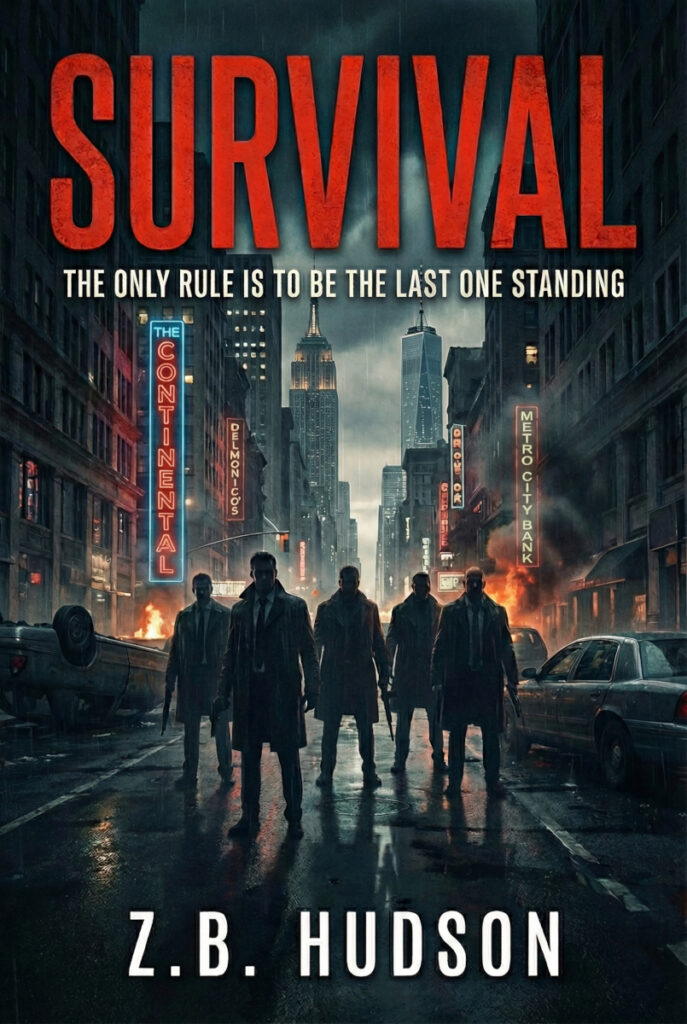
THE CITY IS THE WEAPON. For veteran NYPD Inspector Martin Clark, the law has become a bad joke, and the city’s untouchable criminals are the punchline.
Fed up with a system that lets killers walk free, Clark devises an audacious and illegal plan: ignite a full-scale war between the mafia factions and let the underworld destroy itself. He drags his new partner, Tom Mills—a hot-headed transfer from L.A.—into the crossfire of an off-the-books operation.
But they soon discover that their target is a predator more cunning than they ever imagined.
When the plan triggers a horrifying chain reaction of betrayals, the line between cop and criminal evaporates. With their families in the crosshairs and the body count rising, a simple plan for justice becomes a desperate fight for survival.
The last one standing wins.
Z. B. Hudson’s Survival is a lean, propulsive novel that sits firmly in the tradition of the hard-boiled crime thriller. The manuscript’s primary strength is its unwavering commitment to a plot-driven narrative that prioritizes relentless forward momentum and visceral, external action over deep introspection.
Pacing, Prose, and Action
The narrative engine of Survival is its relentless pacing. The novel moves at a breathless clip, employing frequent and abrupt transitions to jump between multiple story lines and locations. Scenes are often short and punchy, designed to convey essential information or a burst of action before immediately moving on to the next beat. This cinematic structure gives the reader little time to rest, pulling them through the story with sheer force.
The prose is direct and declarative, a stylistic choice that serves the novel’s brutal action sequences particularly well. Descriptions of violence are stark, unsentimental, and often graphic, focusing on the physical mechanics and consequences without resorting to flowery or metaphorical language. The final, bloody shootout is a prime example of this approach: a straightforward, declarative account of a tactical and savage engagement.
Dialogue and Characterization
Dialogue operates on a similar principle of brutal efficiency. Characters in Survival are direct, speaking in a blunt and functional manner that serves to advance the plot, establish intent, or deliver critical information. The dialogue is largely without subtext; characters say what they mean in a terse, hard-boiled style that is a hallmark of the genre.
This directness extends to the characterization. The cast is primarily defined by their actions, professional skills, and their roles within the intricate plot. Z. B. Hudson employs strong genre archetypes to great effect: the rogue veteran cop, the skilled criminal with a code of honor, and the hot-headed but loyal partner. The reader comes to know these characters not through their internal monologues, but through their competence under fire and the professional choices they make.
Plot and Influences
Structurally, the novel aligns with the traditions of crime noir. The story is not a simple A-to-B narrative but rather an intricate, complex plot featuring numerous betrayals, reversals, and a high body count that culminates in a tragically violent end for most of the principal cast.
The novel’s DNA is composed of several key influences within the action and crime genres. The blend of camaraderie, cynical banter, and sudden, shocking violence is highly reminiscent of the work of screenwriter Shane Black (Lethal Weapon, The Last Boy Scout). The focus on hyper-competent, professional criminals and the equally dedicated lawmen who hunt them, along with the large-scale, realistic shootouts, evokes the cinematic style of Michael Mann (Heat). Finally, the lean, efficient, and declarative prose used to describe action is a strong parallel to the style of novelist Lee Child (Jack Reacher series).
AUTHOR’S NOTE
Survival was born from a love of hard-boiled noir and the golden age of action cinema. It is a story about the mechanics of violence, but also about the cost of pulling the trigger.
Currently undergoing a complete manuscript revision to deepen the emotional stakes, this definitive edition balances the adrenaline of the original 2012 draft with a darker, more resonant soul.